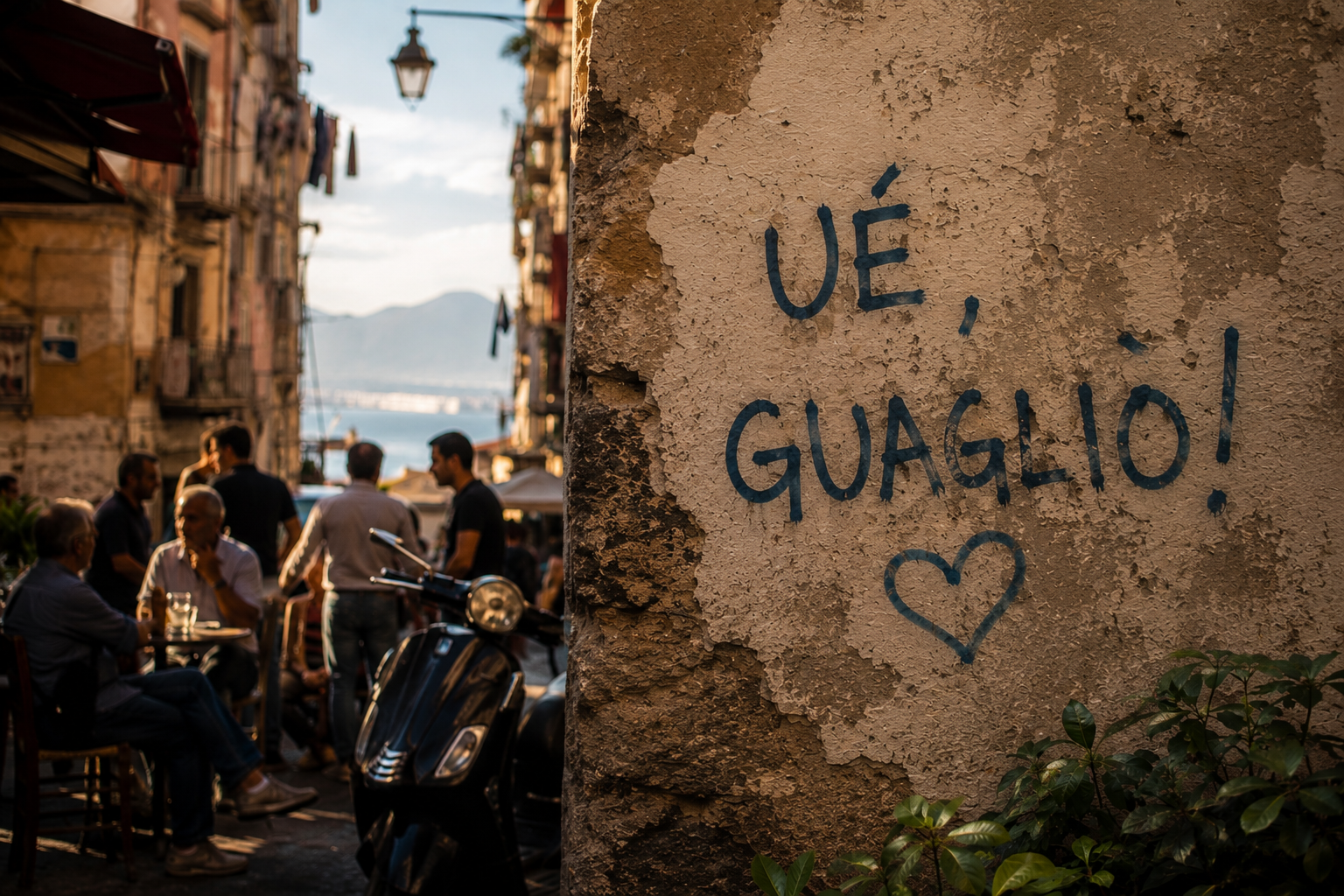
Guaglio – Small Word With A Big Meaning
Some words tell you what they mean. Others tell you where they come from. Guaglio somehow does both.
Ragazzi belongs to every corner of Italy. Guaglio belongs somewhere much more specific.
You’ll hear it across much of Southern Italy, but nowhere does it feel more at home than in Naples. There, it’s woven into everyday conversations. More like something that simply belongs to the rhythm of the city.
You can learn Italian without ever hearing the word guaglio. But you’ll struggle to understand Naples without it. It belongs to the streets. To football pitches squeezed between buildings. To crowded piazzas. To old neighbours talking from their balconies. To scooter riders stopping for a quick cafe. It doesn’t simply describe someone – it places them in a world.
English has mate. French has mec. Spanish has tio. They all come close. And yet none of them quite works. Because guaglio isn’t only about who you’re talking to. It’s about the relationship between the people, the place they’re standing in and even the tone of the conversation.
A grandmother might say it. A shopkeeper might say it. Two lifelong friends. Someone you’ve met five minutes ago.
And that’s why translating guaglio is surprisingly difficult. Depending on the moment, it can mean mate, kid, my friend, or simply hey, you. Somehow, none of those translations quite captures it.
What’s even more interesting is that you don’t really “learn” when to use guaglio. At some point, after enough coffees, enough conversations and enough noisy piazzas, it simply starts making sense.
In many places, conversation is about exchanging information. In Naples, conversation is almost a form of theatre. Hands move before the words do. Faces change expression halfway through a sentence. Voices rise, fall and overlap. That’s why words like guaglio survive. They don’t just carry meaning – they carry emotion. In Naples, language is rarely economical. People don’t just speak; they perform. A single “Ue, guaglio!” can say more than a whole sentence elsewhere. Perhaps, that’s why Naples has always spoken with its own voice. Not just through a different accent, but through a language full of shortcuts, irony, exaggeration and warmth. Neapolitan isn’t simply “Italian with different words”. It reflects a different way of seeing the world. Sometimes one expression can replace an entire conversation because everyone already understands what is left unsaid.
When do you become a guaglio?
Nobody hands you a membership card. Nobody explains the rules. One day you’re just another tourist ordering coffee. A few days later, the barista smiles, looks up and says: “Ue, guaglio.”
If you spend enough time in Naples, you’ll probably be called guaglio long before anyone learns your name.

Southern Italy has always been a crossroads. Greeks, Romans, Arabs, Normans, Spaniards, French.
Naples has spent more than two thousand years borrowing, adapting and reinventing. Every civilisation that arrived left traces behind, but the city rarely kept them unchanged. It made them its own. Traditions blended. Languages mixed. Words travelled, changed shape and settled into everyday life. Everybody left something behind. Sometimes it was a castle. Sometimes a recipe. Sometimes just a word. And guaglio is one of those words.
Like many Neapolitan words, its origins are a little mysterious. Linguists generally trace it back to older Southern Italian dialects, possibly influenced by centuries of Spanish, French, and other languages that left their mark on Naples. The exact story is still debated, but perhaps that’s fitting. Naples has never been easy to explain with absolute certainty.
One Word That Inspired Magazine
We chose it because it captures exactly what we hope this website will do: bring you a little closer to the Southern Italy that locals know – the one that lives beyond the famous landmarks, in everyday conversations, old traditions, neighborhood pride and stories that rarely make it into travel guides.
This isn’t just a website about Southern Italy. It’s an invitation to look a little closer, stay a little longer and notice the things that most people miss.
Curiosity is the only thing you really need here. You don’t need to speak perfect Italian. You don’t need to know the history of every kingdom that ruled the South. You only need to be willing to look beyond the obvious. That’s usually where the best stories begin.
So, before we start our chapters one by one, let’s agree on one thing. Around here, you’re one of the guagli. Welcome to the family.
Now, let’s go South!