A History Written by Many Hands – Chapter I
If cities could speak, Naples would probably interrupt itself every few minutes.
It would begin with Greek sailors searching for a safe harbor. Then Roman senators would insist they made the city great. Spanish nobles would argue they transformed it into one of Europe’s largest capitals, while Bourbon kings would remind everyone that Naples was once the center of an independent kingdom long before modern Italy existed. The truth is that all of them would be right.
To understand the ancient history of Naples, you have to go back long before any of them arrived.
The story begins here. Not as an Italian city, but as a Greek one.
Sheltered by the calm waters of the bay and watched over by Mount Vesuvius, it offered something that every ancient civilization was searching for: a safe harbor, fertile land and a strategic position between East and West. The earliest settlement in the area was known as Parthenope, founded by Greek settlers from the colony of Cumae sometime during the 8th century BC. It occupied the area around today’s Pizzofalcone hill, overlooking the bay.
Its name is often associated with the myth of the siren Parthenope. While the legend remains an important part of Neapolitan identity, historians generally agree that the settlement itself was very real: a small but prosperous trading community that connected the Greek world with the peoples of southern Italy.
Although Parthenope never grew into a major city, it laid the foundations for everything that would follow.
The Birth of Neapolis
Around the 6th century BC, the Greeks established a new settlement a short distance from Parthenope.
They called it Neapolis, literally, New City.
The name reflected more than a simple expansion. Neapolis was carefully planned, following the urban principles that Greek colonists had developed across the Mediterranean. Straight streets crossed at right angles, public squares became centers of civic life and defensive walls protected the growing population.
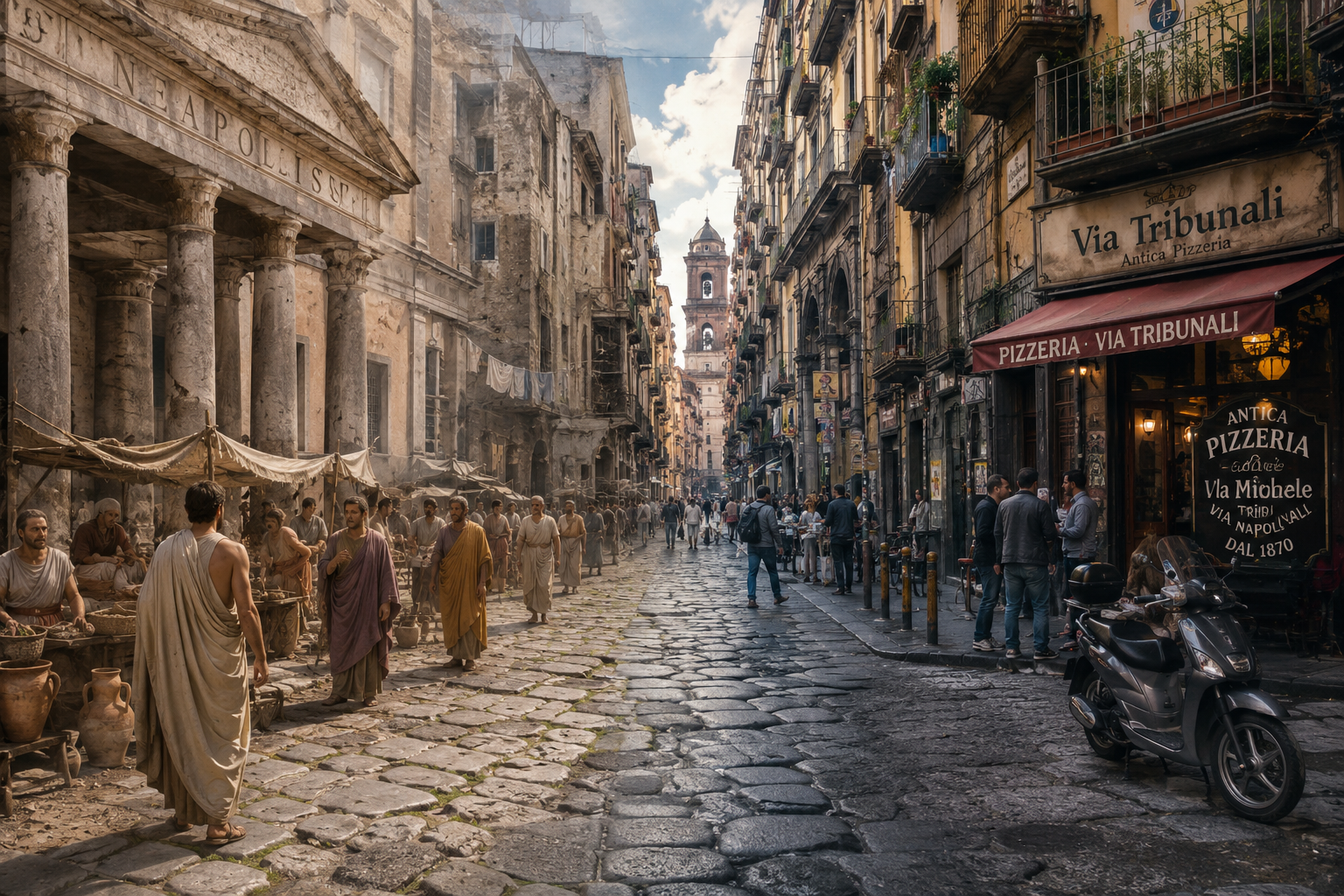
Remarkably, traces of this original layout can still be recognized in the historic center of Naples today. Streets such as Via dei Tribunali and Spaccanapoli continue to follow the ancient Greek grid laid out more than 2,500 years ago.
It is one of the rare places in Europe where modern life still moves through the streets imagined by ancient city planners.
A Greek City Beyond Greece
Although founded by Greeks, Neapolis was never isolated.
Merchants arrived from across the Mediterranean carrying wine, olive oil, pottery and ideas. Local Italic communities traded with the newcomers, creating a city where different cultures met every day.
Unlike many ancient settlements, Neapolis grew not through conquest but through exchange. Its port became its greatest strength. Ships connected the city with Sicily, mainland Greece and other colonies in Magna Graecia and Southern Italy, allowing goods, languages and traditions to circulate freely.
From the very beginning, Naples was outward-looking. That openness would become one of its defining characteristics throughout history.
More Than Temples and Markets
Life in ancient Neapolis revolved around much more than trade.
Like other Greek cities, it developed institutions that reflected the values of the Greek world. Public debates, theatres, athletic competitions and religious festivals all formed part of everyday life.
Greek was the language of administration, education and culture. Philosophers and poets visited the city, while local elites embraced traditions that connected them to the wider Hellenic world. For centuries, Neapolis remained one of the most important Greek cities in southern Italy. Its identity was so deeply rooted that even after new powers arrived, many of its customs endured.
The Legacy of the First Settlers
Perhaps the most remarkable thing about ancient Neapolis is how much of it survived.
The city changed rulers many times over the centuries, yet its original structure was never erased. Beneath churches, palaces and apartment buildings, archaeologists continue to uncover sections of Greek walls, roads and public spaces.
Even without realizing it, visitors walking through the historic center are following paths first traced by Greek engineers over two millennia ago. Naples did not simply begin as a Greek colony. It inherited a way of thinking about the city itself: open to the sea, connected to distant cultures and constantly shaped by those who arrived from elsewhere.
That first chapter would eventually come to an end in 326 BC, when Neapolis became part of the expanding Roman Republic. But unlike many conquered cities, Naples did not lose its identity.
In many ways, it carried its Greek soul into the Roman world, a story that begins in the next chapter of its history.
